Quick answer: A realistic four-day Benin Republic trip from Lagos in 2026 can cost about ₦390,000 to ₦700,000 per person. That covers return road transport, three hotel nights, food, local movement, attractions and a sensible emergency buffer. Sharing rooms and rides can bring the cost down; premium hotels, nightlife and festival dates can push it much higher.
Benin Republic is the kind of international trip that can begin with “let us just cross the border for the weekend” and end with somebody discovering that transport, hotel taxes and CFA conversion were not included in the group-chat budget. It is close to Lagos, culturally familiar and genuinely interesting—but it still deserves proper planning.
Estimate your relocation budget in 2 minutes
Use the JapaMap cost calculator before you start any application.
This guide gives Nigerians a practical route through Cotonou, Ouidah and Ganvié, with current road-fare examples, border documents, a four-day itinerary and the costs people usually forget. Prices are planning ranges checked in October 2026, not guaranteed quotations.

Cotonou is close enough for a road trip, but organised transport and complete documents make the journey far less stressful.
How much does a Benin Republic trip cost from Nigeria?
ExpenseBudget rangeReturn road transport from Lagos₦146,000–₦210,000Accommodation, 3 nights₦90,000–₦180,000Food and drinks₦60,000–₦110,000Local transport₦30,000–₦70,000Attractions and tours₦25,000–₦70,000Data, exchange losses and buffer₦40,000–₦70,000Estimated total₦390,000–₦700,000
This estimate assumes a four-day, three-night trip beginning in Lagos. Travellers coming from Abuja, Port Harcourt or another city should add the cost of reaching Lagos—or compare the full price of flying.
Do Nigerians need a visa for Benin Republic?
Nigerian citizens can generally enter Benin Republic without a conventional visitor visa for a stay of up to 90 days under the ECOWAS free-movement protocol. The protocol still requires a valid travel document and an international health certificate, and immigration officers retain the right to refuse admission where the law permits.
In plain English: visa-free does not mean “carry nothing.” Travel with a valid international passport or accepted ECOWAS travel document, your yellow-fever vaccination certificate, accommodation details, return booking, evidence of funds and a clear reason for the visit.
Use an official border crossing such as Seme–Kraké. Do not hand your passport to random people offering to “help” outside the proper immigration process. If a transport operator says documents are optional, that is a warning—not a benefit.
Benin requires yellow-fever evidence from travellers aged one year or older in the published WHO country guidance. Confirm the latest health rule before departure.
Lagos to Cotonou transport cost in 2026
Recent 2026 listings showed scheduled coach fares from roughly ₦73,000 to ₦105,000 one way. An October check displayed examples around ₦85,000 with ABC, while other operators and services could be lower or higher. A return budget of ₦146,000 to ₦210,000 is therefore safer than relying on an old social-media fare.
The journey may be advertised as five to eight hours, but Lagos traffic and border processing can change everything. Do not plan a paid tour two hours after your expected arrival. Choose a recognised operator, verify the terminal, keep your ticket and arrive early.
Before paying for a bus, confirm:
The exact Lagos departure terminal and Cotonou arrival point.
Whether the price includes every border-related transport charge.
The luggage allowance and excess-bag fee.
The return schedule and cancellation conditions.
Which travel documents the operator checks before boarding.
Where to stay in Cotonou
A modest private room or simple hotel can fall around ₦30,000 to ₦50,000 per night, while a comfortable mid-range property may cost ₦55,000 to ₦90,000 or more. Weekends, festivals and beachfront locations can raise the price.
Haie Vive and nearby areas are convenient for restaurants and nightlife, but convenience costs money. Fidjrossè works well for travellers interested in the beach and airport side of the city. Wherever you stay, check the final price, air-conditioning, backup power, Wi-Fi, breakfast, cancellation terms and the real distance from your planned activities.
Money, food and local transport
Benin Republic uses the West African CFA franc. Do not build the trip around one unofficial exchange rate from a WhatsApp status. Compare the amount you receive, count cash carefully and keep a small reserve separate from your everyday wallet.
For four days, plan roughly ₦60,000 to ₦110,000 for food if you mix local meals with a few nicer restaurants. Cotonou is a good place to try grilled fish, pâte, rice dishes and other regional food without making every meal an expensive content-production exercise.
For movement, budget ₦30,000 to ₦70,000 depending on ride-hailing, hired cars, motorbike taxis and day trips. Zem motorbike taxis are common, but first-time visitors should prioritise safety, agree the price and avoid carrying valuables loosely. For Ouidah or Ganvié, a trusted driver or organised tour may be worth the extra cost.
Ouidah: give the history proper time
Ouidah is not just a quick photo stop. Its museums, sacred sites and Route of the Slaves carry history that deserves attention. The Door of No Return stands at the Atlantic end of that route and is best visited with a knowledgeable guide who can explain the story beyond a caption.
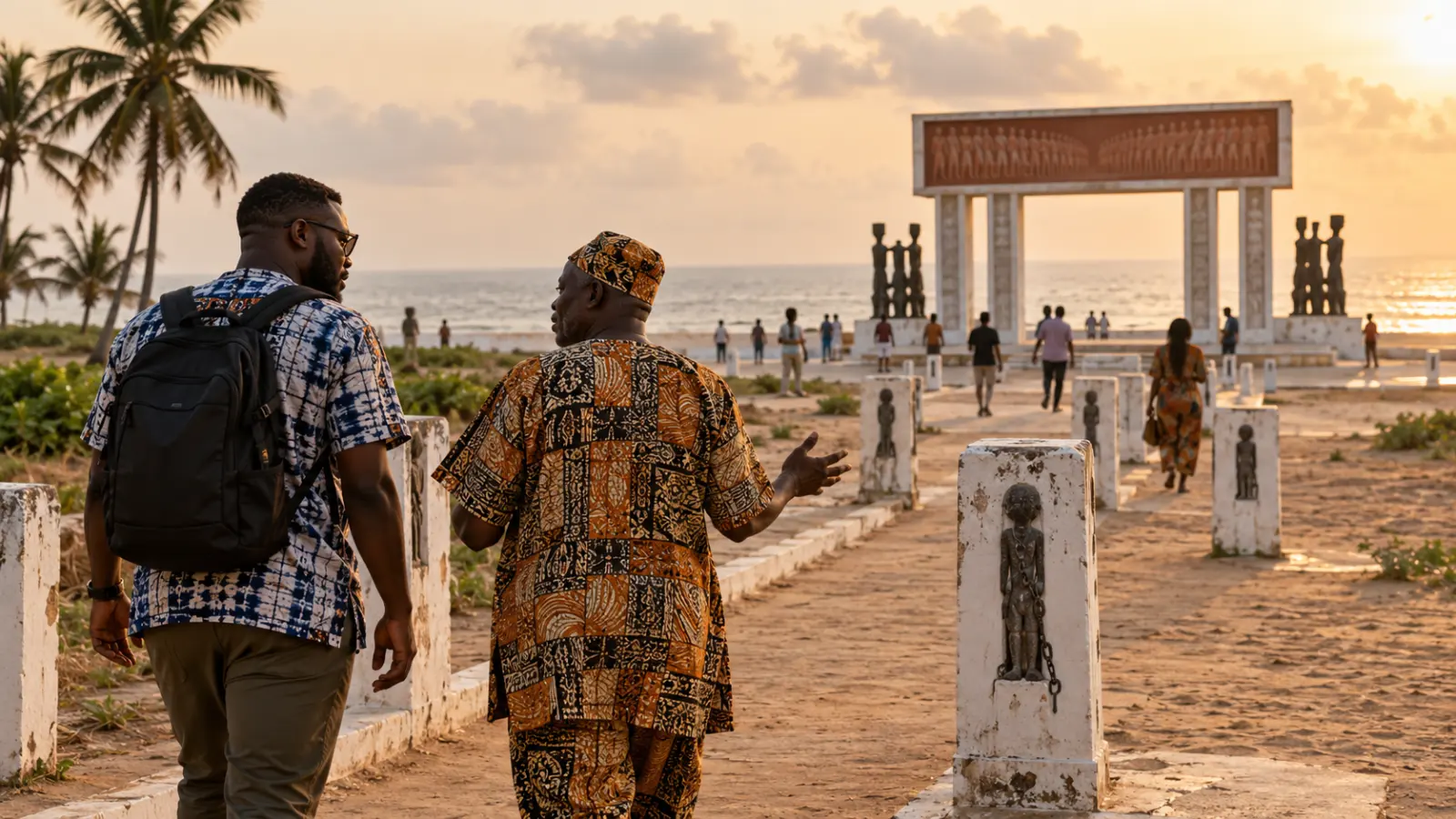
A local guide can turn Ouidah from a checklist into a thoughtful historical experience.
The official destination resources highlight Ouidah’s heritage route, museums and annual Vodun celebrations. If you travel during a major festival, reserve transport and accommodation early and approach religious and cultural events respectfully. Ask before photographing people or ceremonies.
Ganvié: the lake village experience
Ganvié sits on Lake Nokoué and is reached by boat. It is visually striking, but it is also a living community—not a theme park. Choose an organised boat, wear a life jacket, protect your phone from water and follow your guide’s rules.

Ganvié works best as a guided morning trip, with time to understand everyday life on Lake Nokoué.
The Benin destination guide also recommends Porto-Novo, Grand-Popo, Abomey and Pendjari. For a short first trip, resist the urge to cover the entire country. Cotonou, Ouidah and Ganvié already make a full itinerary.
Proof of funds checker — know your exact bank balance target
Country-by-country requirements, updated regularly.
A realistic four-day itinerary
Day 1: Lagos to Cotonou
Leave early, cross through the official border, check in and keep the evening easy. Walk around your area, eat nearby and recover from the road. Do not schedule a major experience against a border journey.
Day 2: Cotonou city and coast
Explore a museum or gallery, see parts of the city with a trusted guide, visit the beachfront and have dinner somewhere that fits the budget. Dantokpa is a working market; go with situational awareness and keep valuables secure.
Day 3: Ouidah day trip
Leave in the morning for the historical route, museums and coastal sites. Allow time to listen rather than racing through each location for photos.
Day 4: Ganvié and return
Take an early Ganvié boat trip, return to collect your bags and leave generous time for the border journey back to Lagos. If your schedule feels too tight, stay a fourth night instead of turning the final day into panic.
How to save money without ruining the trip
Travel outside major festivals if price matters more than the event.
Share a room and trusted driver with people you already know well.
Choose two strong day trips instead of paying to touch five places briefly.
Carry a 10–15% emergency buffer that is not available for nightlife.
Confirm every fare before entering a taxi, boat or hired vehicle.
Book through recognised operators rather than sending money to a random number.
Mistakes Nigerian travellers should avoid
Using an expired or nearly expired passport.
Assuming an ECOWAS trip requires no health or travel documents.
Travelling with an unverified roadside vehicle because the fare is unusually low.
Changing the entire budget with an unknown street dealer.
Photographing people or cultural practices without permission.
Carrying all your money and cards in one place.
Using visitor entry to work or conduct an activity requiring authorisation.
If you are comparing nearby options, read our Ghana trip-cost guide and the broader list of visa-free and visa-on-arrival destinations for Nigerians. A short holiday is also different from relocation; our 50-country relocation shortlist explains what to consider for a longer move.
Frequently asked questions
Can a Nigerian enter Benin Republic without a visa?
Generally, yes, for an eligible short visit under ECOWAS free movement. Carry a valid travel document and health certificate, enter through an official point and satisfy immigration checks.
How much should I budget for four days?
About ₦390,000 to ₦700,000 is a sensible 2026 planning range from Lagos. The final figure depends on transport, room sharing, tours, food and nightlife.
Can I travel with only my Nigerian national ID?
Do not rely on an ordinary national ID alone. Travel with a valid international passport or an officially accepted ECOWAS travel document and confirm the latest requirement before departure.
Is Cotonou safe for tourists?
Many visitors travel without incident, but normal precautions matter. Use trusted transport, protect valuables, avoid poorly lit unfamiliar areas at night and follow current official travel advice.
What language is spoken?
French is the official language, while Fon, Yoruba and other languages are widely spoken. Basic French phrases help, but Nigerian travellers may also find Yoruba speakers in some places.
Final word
Benin Republic is a strong first international road trip because it is close enough to feel possible and different enough to feel like a real break. The winning plan is simple: complete documents, recognised transport, a realistic CFA budget and enough time to experience Cotonou, Ouidah and Ganvié without rushing.
You can organise the numbers with the free calculators on JapaMap Tools. If you are planning a bigger study or relocation journey, the JapaMap Blueprint is there—but for this trip, the priority is simply to travel legally, safely and within budget.
Prices and entry information were researched in October 2026 and can change. Confirm live fares, health rules and immigration requirements with official authorities and your operator before paying.